adbrite

Sunday, November 14, 2010

What Ferrari, Nano Have in Common

What’s the price you pay for the world’s cheapest car? Just under $2800 – and a  small chance that it might catch fire.

Last September, Ferrari S.p.A recalled all of its 458 Italia model – a total of around 1,250 cars – after three customers reported their cars caught fire. 

At least that is the conclusion some observers may have drawn as they followed the saga of Tata Motors Ltd.’s Nano—the most affordable car on the planet. Some reports of the car catching fire soon after it began to be delivered in the summer of 2009 led Tata Motors to launch two investigations between May and October.  A total of six incidents, some of which were smoking rather than fire incidents, have been reported, the company told India Real Time.
In a statement released Wednesday the company said it would offer additional safety equipment to its owners, free of charge.

But folks shouldn’t actually jump to the conclusion that this is a “cheap car” problem. Turns out it happened to some of the most expensive cars in the world too. Owners of the Tata Motors minicar might find some comfort in knowing that owners of the iconic Italian sports car share similar worries – despite having paid a  much higher price tag.
Last September, Italian luxury car maker Ferrari S.p.A recalled all of its 458 Italia model – a total of around 1,250 cars – after three customers reported their cars caught fire. “We gave (the three customers) brand new cars, and fixed the flaws in all the other 458 Italias,” Ferrari spokeperson Stefano Lai said in a phone interview. The base model of Ferrari’s 458 Italia stands at around $275 000 – about 100 times more than the Nano.
“The truth is – it happens to everyone, not just to Nanos or Ferrari,” said Mr. Lai, referring to incidents of overheating and fires.

Tata Motors Ltd. has said their investigation did not find manufacturing flaws in the Nano.

The Indian auto giant has stopped short of recalling its 70,000 minicars from customers across India and said their investigation did not find manufacturing flaws. Rather, problems with additional electrical fittings added after the purchase and material , such as newspaper scraps, found  in the exhaust system during the investigation probably caused the incidents, the company said.
Both companies say theirs cars are perfectly safe.

Thursday, November 11, 2010

Renault can name new car Zoe as girls' case rejected


Renault can name a new car model Zoe, a French judge has ruled - throwing out a case brought by the parents of two girls called Zoe Renault.
The families had argued that their children - and to a lesser extent, other children who have the first name Zoe - could face a lifetime of mockery for sharing the name of a car.
But the judge found no evidence that it would cause the children "certain, direct and current harm".
The families say they plan to appeal.
"There's a line between living things and inanimate objects, and that line is defined by the first name," their lawyer David Koubbi told Associated Press.
"We're telling Renault one very simple thing: first names are for humans."
Following Wednesday's hearing, Mr Koubbi told reporters that the judge had accepted Renault's argument that Zoe "was not a first name, but just a common noun". He said that logic was perverse.
He also argued that all of France's thousands of Zoes could be affected, with playground teasing and, as they grow older, comments in bars such as "Can I see your airbags?" or "Can I shine your bumper?"
Serious business The all-electric Renault Zoe ZE (zero emission) is set for launch in 2012. Zoe - which means "life" in Greek - was apparently chosen to underline the car's environmental credentials.
Renault has already given several models women's names - including Clio and Megane - without facing any campaign of public opposition.
An unnamed Renault official told AP that the manufacturer had no plans to change the car's name.
"We're very happy with the judge's decision," the official said.
First names are taken very seriously in France - where parents used to be forced to select from an official list of approved names.
That is no longer the case, but officials can still argue against parents' choices if they feel they will subject children to harm or ridicule.

Tuesday, September 21, 2010

No Radio, but It Gets 100 Miles a Gallon

Three teams of engineers won shares of a $10 million prize Thursday in a contest to design a vehicle capable of traveling 100 miles on the equivalent of a gallon of gasoline

Among the exotic-looking vehicles that shared the Progressive Insurance Automotive X-Prize was the Very Light Car, winner in the "mainstream" class. The four-passenger vehicle, developed by the Edison2 team, achieved the equivalent of 102 miles per gallon. It weighs just 830 pounds and burns E-85 ethanol in a one-cylinder, 40-horsepower engine.
The goal of the contest, launched in January 2008, was to "revolutionize the auto industry." But mainstream auto makers have mostly shunned the competition and have since overshadowed it by accelerating plans to roll out ultra-efficient cars to sell to consumers.
The Edison2 team, which garnered a $5 million prize, was put together by Charlottesville, Va., real-estate developer Oliver Kuttner and included several veterans of the auto-racing industry.

The two other winning teams, which were awarded $2.5 million each at the ceremony in Washington, D.C., fielded even more exotic vehicles in what contest organizers called alternative classes.
Li-Ion Motors Corp.'s Wave II, a battery-electric car designed to seat two people side by side, achieved the equivalent of 187 mpg. Li-Ion said the car can accelerate from 0 to 60 mph in 12 seconds and hit a top speed of 80 mph.
The Wave II has an aggressive, aerodynamic look, the result of hours of testing in wind tunnels aimed at reducing friction drag. Las Vegas-based Li-Ion converts conventional vehicles to electric drive and makes the Wave II and another car, the Inizio,to order.
The other prize winner was the E-Tracer, a two-wheel electric vehicle developed by a Swiss team. The vehicle looks like a large motorcycle with a wraparound body. The passenger sits behind the driver.
The battery-powered E-Tracer has a small set of training wheels that fold out to stabilize the vehicle. Contest judges said it could get the gasoline equivalent of 205 mpg.


Prize-Winning Cars

Very Light Car
MPG: 102
Fuel: Ethanol
Top Speed: 100 mph
Developed by Edison2 of Lynchburg, Va.
Wave II
MPG: 187
Fuel: Battery
Top Speed: 80 mph
Developed by Li-Ion Motors Corp., Las Vegas
E-Tracer
MPG: 205
Fuel: Battery
Top Speed: 120 mph
Developed by X-Tracer Team, Winterthur, Switzerland

X-Prize winners will also be eligible for financial support from the Department of Energy to develop their designs for sale to consumers.
The competition represents an approach to developing and promoting super-high-mileage cars that big auto makers are leaving behind. Nissan Motors Co., General Motors Co., Toyota Motor Corp. and other auto makers are trying to position their planned electric and plug-in hybrid vehicles less as exotic science projects and more as easily approachable appliances.
The Nissan Leaf, for example, is an electric vehicle due to launch later this year that looks like a conventional five-door hatchback—except for unusually bulbous front headlights designed to minimize wind noise, which is more noticeable because the car's electric motors are so quiet.
Also due on the U.S. market later this year is GM's plug-in hybrid, the Chevrolet Volt. Toyota and Ford Motor Co. have plans to launch mass-market electric vehicles in 2011 and beyond.

Monday, August 23, 2010

Cervo: Maruti’s Answer to Tata Nano?


India experienced a watershed moment when Ratan Tata fulfilled his promise with the launch of Nano, the most economic vehicle in the Indian market, and arguably, in the world. Ever since the launch of Tata Nano, the whole globe is behind the idea of cheaper wheels. Now, it’s the turn of Maruti, who is seriously planning a car priced closer to Nano, and it could apparently be the Cervo, a compact five door mini that might put the other kids on the block in the shade.

The Cervo looks like a smaller Chevrolet Beat with cues from Honda Jazz’s design. The phenomenal fuel efficiency is one of the USPs of this car.

Powered by Suzuki’s 660cc engine – as against Nano’s 623cc – the Cervo could be priced between 1.5 to 2 lakhs, a little higher than Nano. But Cervo looks too stylish and futuristic to be priced under 2 lakhs. So it’s obvious that Maruti needs to delete some of the features available in the car, or use a cheaper material to make a potent contender to Nano.

Inside, the dashboard of the Cervo looks almost like the Swift, with the rectangular air vents in the centre and the circular ones on the sides. Power windows and airbags are available in the international markets but chances are that Indians will have to compromise on that.

Although not all can repeat the Nano story, Maruti has resources and expertise to come up with such a model at a cheap price without compromising on quality. But can they pull it off? Let’s all hope so.

Thursday, June 10, 2010

How to Find the Best Used Car

In the earlier post we discussed how to clear up your car buying confusion. Most of us have agreed that buying a used car is often the best and most financially efficient choice. However, out of the excitement of getting a car, many used car buyers don’t look close enough at the pre-owned vehicle or they look at the wrong things. I don’t want your story included in the list of used car tragedies, so here are ten commandments on examining a pre-owned car.

1. Carefully examine the body, look for fresh paint jobs or different colors of paint on the body panels. Open the bonnet and look at the paintwork so that you can make out if the car has been repainted or not.
2. Under the bonnet, look for oil leaks and use the dipstick to check the amount of oil. If the level is low, the car hasn’t been looked after properly. Examine the surroundings of the oil filler cap, if you find a white substance it is an indication of a damaged head gasket, replacing which is going to be darn expensive.
3. Check the tyres and the spare tyre to ensure they’re in good condition with plenty of tread. If the tyres are bald, you can bargain up to Rs 1000 per tyre. Worn tyre edges indicate problems with the wheel alignment.
4. Check for acid wear and tear around the battery areas. If the battery is not new, there is another chance of decreasing the price of the car by Rs 2,500.
5. Another very important thing to assess is the suspension. Push down on top of the wing each side just once and release, the vehicle should go down and come back up once and stay put. If the car bounces up and down and appears soft, the shock absorbers are faulty. While test driving the car, listen for any ‘thud’ sound coming from the shock absorbers. Replacing them is going to be incredibly expensive, so what I would suggest is, try another car if the suspension is defective.
6. Get inside, check the kilometre reading of the car and calculate with the year of manufacture. There is always a possibility of Odometer tampering irrespective of the meter being mechanical or electronic.
7. Personally speaking, clutch is the most challenging part of a used car. Because, if the car has done more than 50,000 kms, you don’t know when the car is going to break down in the middle of the road due to clutch failure. Unfortunately, there’s probably no practical way to measure the degree of clutch wear. Yet, you can refer this link to get an idea on How to Diagnose a Slipping Clutch.
8. Check ALL electrical components, lightings, dippers, cabin lights, indicators and tail lamps, stereo, windshield washer and wiper and especially, Air Conditioner.
9. Start the engine. It should start at the first attempt without any hiccups. The engine should idle seamlessly without clattering or metallic sounds. With the engine idling, turn the steering wheel right and left and ensure there’s no play in the wheel before the tyres start to turn.
10. Test drive is the most important part of examining a used-car. Drive it for 4-5 kilometers in different road conditions, paying attention to the synchronization of the steering wheel, brake pedals, clutch, and the gear shifts. Drive with AC on/off while climbing a slope, there shouldn’t be an abnormal drop in power when the AC is on.

Luxury yacht comes with free custom supercar


As boat accessories go, a bespoke supercar is probably the most extravagant. But that's exactly what millionaire buyers of the £17m Strand Craft SC122 will get.

Beating the Bugatti Veyron hands down for exclusivity, the supercar has 880bhp from its twin-turbo V12 engine and a claimed top speed of 234mph. Only six will be built, each capable of hitting 60mph from rest in 3.2 seconds.

Designed by Eduard Gray, the car is so synonymous with the yacht that the company doesn't seem to have named it. The supercar will spend most of its time in the custom garage below deck while its owner enjoys the supreme luxury of the yacht.

The SC122 is a vision of absolute splendour inside and out, kitted out with 52-inch televisions and a Bang & Olufsen surround sound system in every room. There are four double bedrooms, too.

Its power dwarfs that of the accompanying supercar. Twin Rolls-Royce engines each pump out over 4,000bhp, and there's an optional 5,000bhp booster if the standard amount just won't do.

That power enables the yacht to reach 55 knots - though at just over 60mph, it's actually quite sluggish compared to the car.

Sunday, May 30, 2010

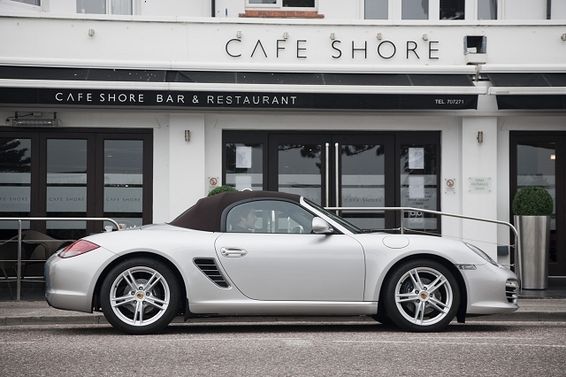
Porsche Boxster is Back


Introduction

This Boxster, the basic 255bhp, 2.9-litre, entry-level model (as opposed to the more powerful S) provides perhaps the purest Porsche experience you'll find anywhere in the range. With a list price of £35,510 the Boxster is the cheapest car in the line-up, though Porsche's press fleet people haven't been able to resist adding £11,000 of options to it - extras that are all arguably surplus to requirements. All but one that is, with the sports exhaust a must if you're going to enjoy your Boxster to the maximum.

What are its rivals?

The Boxster's obvious rivals include Audi's TT, BMW's Z4 and the Mercedes-Benz SLK, though to that you can add Nissan's 370Z and a whole lot of big-power hot hatches, many of which have power and performance figures to better the Boxster. Few are as aspired to though, that Porsche badge meaning a lot, even when it's stuck on the bonnet of the most inexpensive car in the range.

How does it drive?

Forget the raw performance figures and concentrate on the purity of the driving experience and none of the Porsche's roadster rivals can come close to the Boxster. Something like a Nissan 370Z Roadster delivers more brawn, but the Boxster's balance, beautiful feel and feedback make it a real joy to drive. It's not savagely fast, instead the Boxster gaining momentum with an easy, forceful linearity that has you reaching for the redline before every slick gearchange. With pedals positioned perfectly for throttle-blipping heel-and-toe downshifts the real enjoyment to be had driving the Boxster is making the most of its output and revelling in its brilliant poise and incisive feel. The optional sports exhaust is a must here, as it adds a layer of sound to the experience that's just delicious, with a more assertive rasping tone overlaying the flat-six engine sound.

The steering is sharp, well weighted and rich in feel, while the standard suspension copes with all the vagaries of UK roads with little fuss. Strong brakes with lots of feel through the pedal and a gearshift that's one of the best out there combine with the Boxster's other qualities to make it a hugely entertaining driver's car.

What's impressive?

The feel and feedback. Most modern cars lack any real information through their controls, with responses muted by the electronic assistance thanks to manufacturers' endless pursuit of safety, refinement and comfort. Porsche is different, and the entry-level Boxster demonstrates that better than anything this side of a 911 GT3. The steering is fantastically crisp, while the accelerator, brakes, gearshift and clutch all operate with a rare unity that makes driving the Boxster such a pleasing experience. Porsche achieves this without making the Boxster edgy or difficult too, its thresholds of grip high, its safety systems extremely competent and refinement and comfort exemplary, too.

It's also practical thanks to a deep front boot and a wide and flat rear one. The hood operates quickly and easily and economy and emissions are respectable - at 30.1mpg and 221g/km on the combined cycle - for a car that's able to reach 62mph in 5.9 seconds.

What's not?

It's disappointing that to really enjoy the 2.9-litre's sound you need to spend an extra £1,434 on the sports exhaust.

The hood is quick and easy in its operation, but the need to manually unclip it from the header rail before the electrics take over is disappointing. Porsche cheekily asks £218 for the necessary wind deflector, and solidly built as the interior feels it's not exactly the most stylish driving environment.

The optional satnav with Bluetooth failed repeatedly to connect to an iPhone - something we've experienced before with the £1,995 option on other Porsches.

Should I buy one?


Absolutely. The more powerful S is tempting, but on our camera-strewn, speed-restricted roads the additional performance it brings is of little use. A standard Boxster with that Sports Exhaust option is all the sports car you really need in the UK. Forget the 'poor man's Porsche' or 'couldn't you afford a 911' jibes from the uninformed and enjoy the brilliant feel, feedback and excellent poise that the Boxster delivers. Experience it once and you'll not care what anyone else thinks - as you'll know better.

Sunday, May 23, 2010

Six tips to spot a clocked car

Clocking is one of the biggest threats to used car buyers. If you've never heard the term before, it's when a crafty seller tinkers with the odometer to make it look as though a car has covered fewer miles, which increases its value.

What's worse is that it's almost impossible to spot, so you could be paying well over the odds for a car that's a lot more tired than it looks.

A BBC 'Watchdog' investigation recently uncovered serial car clocker, Ashley Singh, who sold such cars from home via used car sales websites. Singh used fake identities and doctored service histories to keep buyers in the dark, and it was only when he bought a car from the 'Watchdog' team that he was discovered.

Journalists from the programme sold Singh a car with 128,000 miles on the clock for £2,300, but later found him selling the same vehicle for £6,000 with a claimed 47,000 on the clock.

With that in mind, it's essential to be as knowledgeable as possible when you're buying your next second-hand car. Our top six tips for spotting a potentially clocked vehicle will keep you in the know and dodgy dealers at bay.

Check the service history

It's tempting to just skim through the service history when you get caught up in the excitement of buying a car - but don't. Inspect every document thoroughly.

Not every car will have a full service history, but the more documents, the better. Look for stamps from a genuine dealer, as these are good signs that the work has been carried out by a professional - and you can trace each fix, MoT or service back to an individual garage.

Get an HPI check

Vehicle history specialist HPI reckons that one in 12 used cars has a mileage discrepancy, so it's well worth shelling out the nominal cost for a comprehensive history check. Single HPI checks start at £19.99 and the company has a database of 135 million mileages. If you're paying a four figure sum for your next car, £20 for peace of mind seems worth it.

Double check the mileage on collection

A common trick by cheeky fraudsters is to wind the mileage figure back to a lower level when the buyer first comes to view the car, then change it to its correct level shortly before the car is collected.

Make a note of the mileage - and the general condition of the rest of the car - during your first viewing. On the second visit, give it a quick once over to make sure everything matches before you hand over your cash.

Talk to the previous owner

If you're buying the car from anyone other than a private seller then it's worth contacting the previous owner. Their details can be found on the front page of the vehicle's logbook - write them down and contact the last owner before you buy.

See if what the previous owner says matches the service history. They're not likely to know everything off by heart, but if there are any glaring differences then it could be time to walk away.

Look for wear and tear

Clocked cars are hard to spot, but if a vehicle has covered a lot more miles than the seller claims, then there are telltale signs. Worn steering wheels and seats and damaged or loose interior trim suggest that the car has been used heavily.

Look for new but easily replaceable parts too, like wiper blades hub caps. This could mean that the seller has shelled out a small amount to get the car looking tidy, when in fact, it's not up to scratch.

Trust your judgement

Check out the front page of the logbook. If the previous owner was a fleet or business then the mileage will usually be quite high. If the car was for business use only and it has only covered 6,000 miles in a year then you have reason to be wary. Stay savvy and keep your wits about you and you have far less chance of buying a dud.

Tuesday, May 11, 2010

Car auction world record smashed


A 1936 Bugatti has sold for at least $30,000,000 (£20m) at auction, making it the world's most expensive. It dwarfs the previous auction record, set at £15.7m for a Ferrari 250 GTO in September 2008.

The Bugatti Type 57C Atlantic was bought by the Mullin Automotive Museum in California, which means it will now be seen by thousands of enthusiasts. It had belonged to Dr Peter D Williamson, a neurologist and car collector who died in 2008.

It was sold by auctioneers Gooding and Company on behalf of Dr Williamson's family - though the actual price could be anything up to $40m.

Speaking to the Wall Street Journal, Gooding and Company President David Gooding said the car is "one of the world's most significant and valuable automobiles."

Mr Gooding would not reveal the final sale price of the car, though a source 'close to the sale' confirmed it was between $30- and $40m, according to the Wall Street Journal.

The car was first unveiled at the 1935 Paris Motor Show, with a 200bhp engine and a 123mph top speed - quite incredible statistics at the time. Dr Williamson purchased the car in 1971, reportedly for $59,000. Fashion designer Ralph Lauren owns another of the few remaining Type 57C Bugattis.

Thursday, May 6, 2010

Ferrari Superamerica sells for £2.4 million


Top auction house RM made its way into the record books yet again when it sold a 1962 Ferrari 400 Superamerica Cabriolet Pininfarina SWB for £2.4 million at a prestigious auction in Monaco in May 1 - the highest recorded price for a Superamerica.

The Sporting Classics of Monaco sale, held at the Grimaldi Forum, was packed with rare and exotic classic cars, five of which sold for over €2 million (£1.7 million). Four of the top five sellers were Ferrari 250s from the 1950s and 1960s, along with a 1960 Maserati Tipo 61 Birdcage, which sold for £2.11m.

A total of 105 cars went under the hammer, 88 of which sold at auction to produce an 86 percent sell-through rate and total sales of over £28 million. The sale's cover car - a 1937 BMW 328 MM Bügelfalte - failed to sell at auction, but it was bought after the event for an undisclosed sum.

Bidders from 33 countries fought it out over the telephone, online and in the standing only venue. RM estimates that around 3,300 people watched the live steaming footage of the auction online.